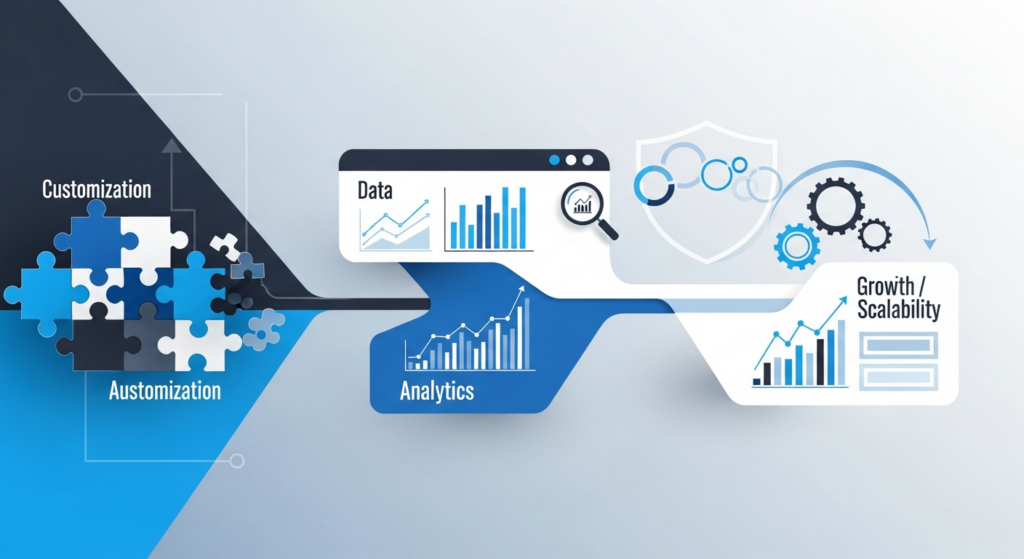
Deciding whether to build a custom web application is a practical business choice, not a technical vanity project. The right custom app can reduce repetitive work, improve customer experience, and give you control over data and workflows. But custom development also requires investment and ongoing maintenance, so it helps to know the signs that a custom solution is the sensible next step.
Are you hitting limits with off-the-shelf tools?
Many businesses begin with standard platforms—website builders, SaaS tools, or plugins—because they are inexpensive and quick to start. These solutions work well until you need unique workflows, integrations, or data handling that the products weren’t designed for. If you find yourself forcing business processes to fit a tool rather than the tool adapting to your process, that mismatch is a clear signal a custom app may be more efficient.
Common limits of off-the-shelf tools
- Lack of necessary integrations with your accounting, inventory, or CRM systems.
- Workarounds that create manual steps, duplicate data entry, or brittle automations.
- Performance issues as usage or data grows.
- Feature bloat that makes the product hard to use for your team.
Do you need unique workflows or data models?
Custom web applications let you model your business logic precisely. If your processes include conditional approvals, complex pricing rules, or industry-specific data models, building those rules into a custom app reduces errors and speeds up daily tasks. When a business’s competitive advantage relies on a specialized process, encoding that process in software often pays for itself in time saved and fewer mistakes.
Is data ownership, privacy, or compliance important?
Using third-party platforms sometimes means accepting shared databases, restrictive export options, or unclear data policies. If your business handles sensitive customer data, regulated information, or requires strict audit trails, a custom application can provide clearer control over where data lives, how it is encrypted, and who can access it. Custom systems make compliance planning and documentation easier because you control the architecture and access controls.
Do you need better performance or reliability?
As traffic and user expectations increase, performance matters. Off-the-shelf platforms that serve many customers can be subject to rate limits, throttling, or shared-resource slowdowns. A custom app designed with your traffic patterns in mind can optimize for speed and reliability where it matters most—your checkout flow, appointment booking, or dashboard reporting. When slow page loads cost revenue or time, performance-driven custom work can deliver measurable benefits.
Will integrations and automation save time?
Integrations are a major reason businesses opt for custom development. If your team spends hours moving data between systems, manually reconciling records, or waiting for reports to export and reformat, automating those touchpoints reduces human error and frees staff for higher-value work. Custom applications can act as a single source of truth that ties together payments, inventory, scheduling, and customer records on your terms.
Do you need a branded or differentiated customer experience?
Sometimes the decision is driven by marketing and product strategy. If your customers expect a tailored, branded, or tightly integrated experience—like a client portal that reflects your service model or a booking flow that matches your niche—a custom app lets you design every interaction. Off-the-shelf templates can feel generic; custom development lets you remove friction points and present a coherent experience that supports conversions and retention.
Are you planning long-term growth or new product lines?
Think about where your business will be in three to five years. If you plan to add services, sell through new channels, or expand geographically, a custom application can be built with scaling in mind. That does not mean overbuilding. It does mean choosing an architecture and integrations that make future expansions predictable and less costly than migrating away from a limiting platform later.
How to decide: practical questions to ask
When evaluating whether to invest in a custom web application, answer these direct questions:
- What specific problems are we solving that current tools cannot address?
- How much time or money do those problems cost today?
- Can available tools be configured or combined to solve the issue without excessive manual work?
- Do we need control over data, integrations, or compliance that third parties cannot provide?
- What is our budget for development, hosting, and ongoing maintenance?
- How will we measure success after launch?
Alternatives and hybrid approaches
A custom app is not the only path. Hybrid approaches combine off-the-shelf services with lightweight custom middleware or integrations. For example, using a SaaS product for user management while building custom features on top via APIs can be faster and cheaper than a full custom build. Start with the smallest scope that solves the core problem and iterate from there—this reduces risk and spreads costs over time.
Choosing the right approach with a development partner
Good development partners focus on solving business problems, not showcasing technology. A practical partner will help you define minimal viable functionality, estimate costs, and plan for maintenance. They should clarify hosting, backups, security responsibilities, and how new features will be added later. Look for experience in projects similar to your needs and a steady process for planning, building, and supporting the system after launch.
Practical next steps
If you think a custom web application could help, start with a short discovery phase: document the workflows causing the biggest pain, gather data on time and cost impacts, and list required integrations. From there, scope a small initial release that solves the most important problem. This approach keeps the project focused and delivers value quickly while leaving room for future improvements.
Final thoughts
Custom web applications are worth considering whenever existing tools force cumbersome workarounds, when data control or compliance is critical, when performance affects outcomes, or when your product experience is a competitive advantage. A carefully scoped custom build can reduce manual work, protect your data, and scale with your business without unnecessary complexity.
If you’re unsure whether a custom web application is the right step for your business, contact Hess WebTech to discuss practical next steps and a manageable plan for build, support, and growth.