Most of what we write here is advice. This one is a report from our own build.
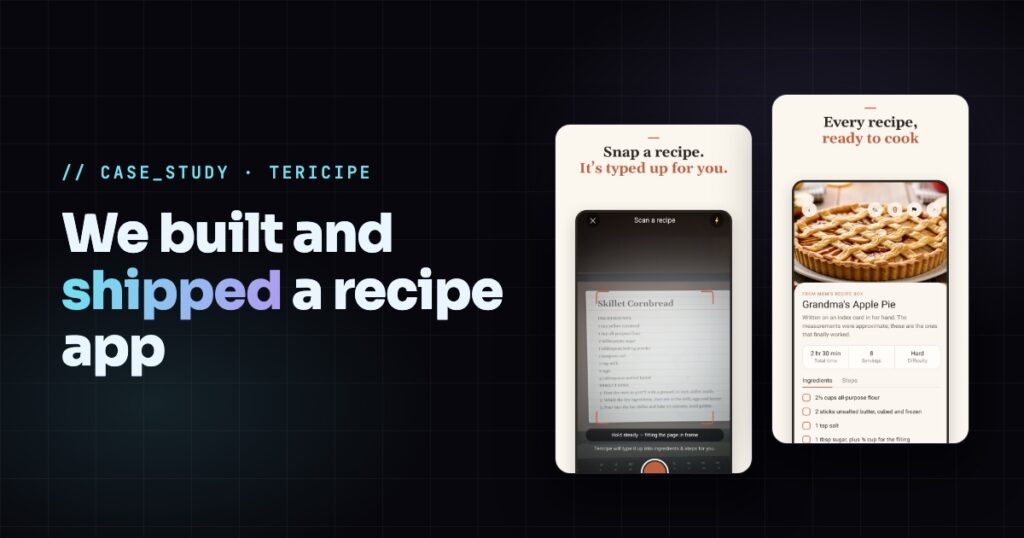
In September we released Tericipe, a recipe app for Android. It turns printed family recipes, from index cards, church cookbooks, and magazine clippings, into a digital recipe box people can search, cook from, and share. Hess WebTech designed it, built it, and took it from first commit to a public Google Play release in under three months. Since launch we’ve kept shipping: three production releases in the first week of October alone.
Building a product of our own meant living with every decision we usually help clients make. A few lessons stood out, and they apply to almost any business app, recipes or not.
Five lessons for your app
1. Test against the real mess, not tidy samples
Tericipe’s headline feature is scanning: point the camera at a printed recipe and it’s typed up for you. Early versions looked great on clean test pages and stumbled on real ones: two-column layouts, open cookbooks with a second recipe on the facing page, tiny fractions like ¼. So we tuned the scanner against real photographed cookbook pages instead of invented test data. It’s still not perfect. Small fractions and table or column layouts are the hardest things on a page, which is why the next lesson matters.
For your project: whatever your app reads (invoices, forms, customer photos, spreadsheets from the field), test it on the messy real thing early. The demo is never the hard part.
2. Let the app admit when it isn’t sure
A scanner that quietly saves a garbled recipe is worse than no scanner. Tericipe flags lines it’s unsure about before anything is saved. When one photo catches two recipes at once, it asks for a retake instead of blending them together.
For your project: design the “I’m not sure” path on purpose. Software that is honest about uncertainty earns more trust than software that pretends to be perfect.
3. Payments belong on the server
Tericipe Pro is an optional one-time purchase through Google Play. Every purchase is verified by a server-side function, and that function is the only thing that can grant Pro. A modified copy of the app can’t grant itself Pro.
For your project: if your app takes money or unlocks paid features, the check that matters has to live on a server you control, not only in the app on someone’s phone. This is one of the first questions to ask any developer.
4. Treat privacy as a feature people can use
Recipes in Tericipe are private to each account unless someone shares one. A share link publishes a stripped-down copy, the recipe and the sender’s first name, with no photos, last name, or account details. Users can stop sharing at any time, and they can delete their whole account from inside the app with no email and no waiting period. We wrote the privacy policy from a review of what the code actually does, and we review it again whenever data handling changes.
For your project: customers increasingly expect to see and control what you keep about them. Building that in from the start is far cheaper than retrofitting it.
5. Launch is the start of the work
The first public release was a milestone, not a finish line. Real users and real devices surface things testing doesn’t, so we kept a steady release rhythm: every release is version-tagged and checked on a real phone before it’s promoted, and automated tests and checks run on every change.
For your project: budget for life after launch. Updates, fixes, and app store requirements keep coming, and the apps that last are the ones built to be maintained.
See it for yourself
Tericipe is free on Google Play for Android. Scanning reads printed and typed recipes. Handwritten cards aren’t supported yet, and recipes in table or column layouts may not scan cleanly. For the full story of how we built it, including the stack and the parts we took the most care with, read the Tericipe case study.
Planning an app of your own?
Accounts, payments, private data, an app store release, and support after launch: that’s the checklist behind most business apps, and we’ve just worked through every item on it ourselves. Whether it’s a customer app, an internal tool, or a product of your own, we can walk through what it would take.