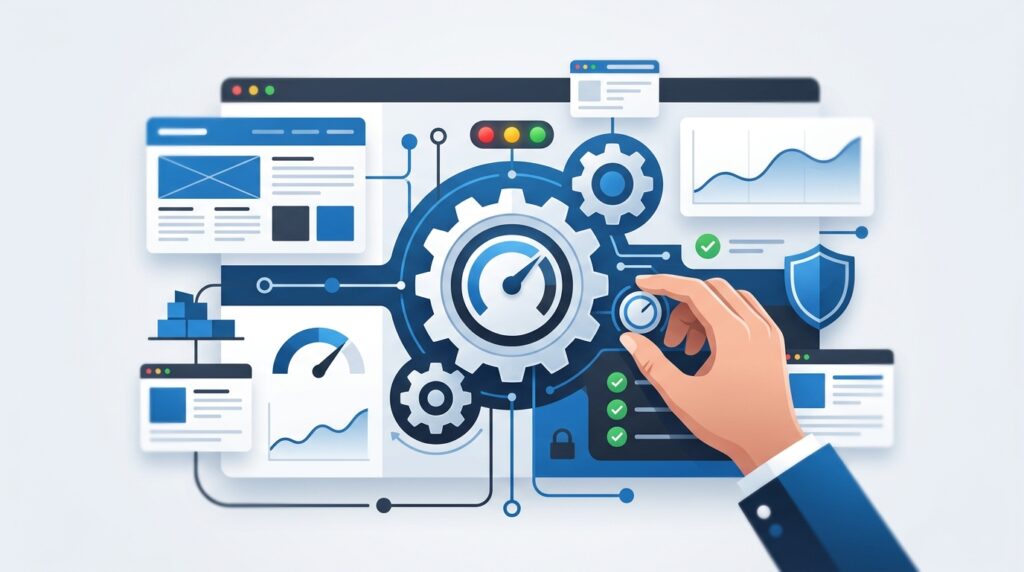
Many small business owners treat their website as a completed project: build it, launch it, and move on. That “set it and forget it” mindset feels efficient, but a website isn’t a static brochure — it’s a living part of the business that runs on software, depends on outside services, and needs to keep up with what customers expect. Left alone, it doesn’t just stay the same. It quietly gets worse.
Why websites don’t run themselves
A website is made up of code, content, hosting, and a handful of third-party tools, and every one of those pieces changes over time. Software updates patch security holes, hosting platforms evolve, search engines adjust how they surface local businesses, and customer expectations shift. Without regular attention, a site accumulates technical debt: slow pages, outdated information, and vulnerabilities that invite downtime or worse.
Security and software updates
Most websites run on a content management system, along with plugins, themes, and server software — all of which receive updates to fix vulnerabilities and improve stability. Skipping those updates because the site still looks fine today leaves exploitable gaps that can lead to malicious code, defacement, spam injection, or a site going offline entirely. Regular updates and basic monitoring are the simplest way to close that risk.
Performance and user experience
Page speed and reliability shape how visitors feel about a business before they’ve even read a word. Over time, media files accumulate, third-party scripts change, and caching or hosting configurations can quietly drift out of tune. Periodic performance reviews — compressing images, reviewing slow plugins, checking caching — keep pages fast and visitors from bouncing.
Content relevance and search visibility
Search engines and local directories reward accurate, current information: correct hours, service details, and structured location data. A site that never gets revisited slowly loses relevance and visibility in local search, making it harder for potential customers to find the business exactly when they’re looking for it.
What neglect actually costs
These aren’t just technical inconveniences — they show up as real business risk:
- Broken functionality: Forms stop working, payment flows fail, or booking widgets break after an update or a change on a provider’s side.
- Lost opportunities: Slow pages and failed forms cost leads at the exact moment someone was ready to reach out.
- Security incidents and recovery costs: Malware injections or unauthorized access damage customer trust and are far more expensive to clean up than they would have been to prevent.
- Outdated content and eroded trust: Wrong hours, old pricing, or an expired certificate make a business look unprofessional and unreliable.
- Declining search presence: Poorly maintained sites tend to lose ground in local search results and referral traffic over time.
- Compliance gaps: Rules around data handling and privacy change; without periodic review, a site can fall out of step with them.
Practical maintenance that keeps a site healthy
None of this requires a full-time hire or a large retainer. A handful of consistent habits cover most of the risk:
- Regular updates and backups. Keep the CMS, plugins, themes, and server packages current, and maintain automated backups with a known, tested restore process.
- Security basics. Strong passwords, two-factor authentication where available, limited admin access, and routine monitoring for unauthorized changes.
- Performance checks. Measure load times, review large media files, and keep caching working as intended.
- Content and business-detail review. Verify contact information, hours, and service descriptions on a regular schedule — accuracy builds trust and supports search visibility.
- Forms, integrations, and analytics. Test that contact forms, bookings, and payment flows work end to end, and check analytics to confirm key pages are still driving the right actions.
Building a simple cadence
The easiest way to keep maintenance from becoming overwhelming is to break it into a predictable rhythm and decide who owns each part:
- Weekly: check backups and any critical alerts.
- Monthly: apply software updates and test core forms.
- Quarterly: review content, performance metrics, and analytics.
- Annually: audit hosting, renew certificates, and plan larger improvements.
Document the schedule and assign clear ownership — whether that’s an internal team member or a support partner — so nothing depends on someone remembering to check.
Planning improvements, not just fixing problems
Reactive fixes keep a site running, but they don’t move it forward. Use the quarterly review as a checkpoint to ask bigger questions: Is the site converting visitors into contacts? Are new services represented with clear pages? Is the mobile experience serving customers well? A support partner who handles the technical upkeep can also help spot these opportunities and advise on priorities, freeing the business to focus on customers rather than server maintenance — especially once the website connects to other business systems or handles customer data.
Practical next steps
- Confirm automated backups are running, and test a restore.
- Install any critical updates for the CMS, plugins, or server software.
- Scan for broken links, missing images, or form failures.
- Review the homepage and contact page for anything outdated, and set a simple schedule to keep checking.
A website is a strategic asset, not a one-time project. Regular maintenance, small ongoing improvements, and clear ownership protect the investment already made in it — and keep it working as hard for the business as the day it launched.
If you want help keeping your website secure, fast, and easy to find, Hess WebTech can review what’s in place, flag what needs attention, and lay out a clear next step for keeping it that way.